
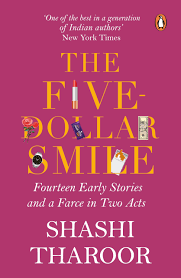
Blurb:
The Five-Dollar Smile is a collection of stories of young love and disaffection, adolescent high spirits and youthful traumas; there are also stories, written with the energy and passion of youth, which deal with very adult subjects: death, deceit, loss, hypocrisy, honour. Sensitive, compelling and persuasive, these stories, written for the most part in Shashi Tharoor’s late teens and early twenties, reveal an already formidable talent. Rounding off the collection is a marvellously inventive play set in the time of the Emergency.
My Review:
I picked up “The Five-Dollar Smile and Other Stories” hoping it would be a good starting point to explore Shashi Tharoor’s fiction. His other books seem either quite dense or heavily political, so a short story collection seemed like the perfect entry point. Unfortunately, about halfway through the book, I found myself wondering whether I was reading Shashi Tharoor or someone closer to the tone of Chetan Bhagat.
In the introduction, Tharoor explains that these stories were written in his teenage years (which he continues to remind us at the beginning of every story) and that he aimed to write for a broad Indian readership rather than pursue an obscure literary aesthetic. He also remarks that India is often portrayed through narrow stereotypes and insists that the country contains multitudes. However, the stories themselves frequently fall into the very patterns he critiques. The orphanage, the school teacher, the so-called modern boys, and young women appearing only for the sake of men feel stereotypical rather than nuanced.
Technically, the stories are competent, as would be a bare minimum expectation from Shashi Tharoor. But what I found difficult to overlook was the persistent misogyny and sexism, along with hints of paedophilia and sexual assault. The contrast in how men and women are introduced and described is stark. Story after story, the portrayal of women seems to be in poor taste.
Some Instances
The Village Girl: In a dialogue that lasts around seven pages, the name of the male character is mentioned 32 times, whereas the female character, whose name comes up just 4 times. She is mostly just referred to as behenji, the girl, the village girl, the simple village girl, and the innocent village girl.
The Simple Man: Here’s how the protagonist talks about his love: “Ours was, of course, what they call a love marriage. The first time I met her I thought she was a bitch; we argued bitterly over something inconsequential and parted… She was exquisite and she was mine…. she came as near to perfection in a woman as I’ve sought… the only blemishes I could discern in her were the imperfectly cured acne of late adolescence and a slight affectation in attitude.”
The Professor’s Daughter: And, on the other hand, here’s how a predator, assaulting male is described: “Generations of students recalled the same placid face, the wispy, perpetually greying beard that needed neither wax nor net, the immaculate cotton turban in its invariable shade of dark maroon. It seemed he had always looked like that; his students aged in the world outside, but Professor Chhatwal, content in the cocoon of college…” Based on the title of the story and my review, you can imagine how the said “daughter” has been described. I am not even going to mention that here.
Auntie Rita: And finally, we come to paedophilia. “When you’re seventeen, and just discovering your masculinity, few things stand in the way of potential sexual adventure, even if it’s with your aunt-in this case, especially if it’s with your aunt… / For her it was more a question of preserving her precipitous balance than her tenuous chastity. “
What makes this book particularly disappointing is the context. These stories have been republished in multiple editions across decades. Written in the 1970s and republished in 1990, 1998, and 2015. It’s terrible to see that someone of this stature publishing a book like this can get away with it under the label of “early stories”, vague endorsements, and a blurb that celebrates it as the “energy and passion of youth”.
A few stories do show promise and narrative skill. I would like to mention The Political Murder, The Other Man, and The Death of a Schoolmaster. I genuinely liked these ones. But overall, this was not a collection I could enjoy. Readers who are sensitive to misogynistic undertones may find it particularly difficult to engage with. In my view, if you want to explore Shashi Tharoor’s writing, this is not the book to start with.
Suitable For Age: 16+